About this book
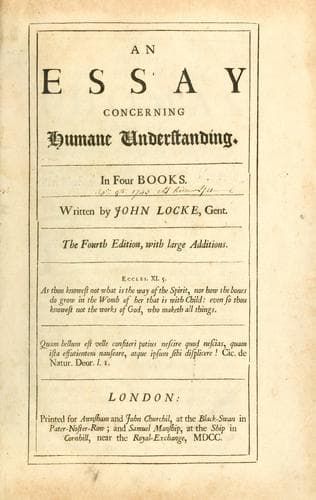
"Essay Concerning Human Understanding" explores the nature of human knowledge and understanding, arguing that all ideas originate from experience. John Locke distinguishes between simple and complex ideas, emphasizing the role of sensory experience in shaping human perception. He critiques innate ideas, proposing instead that the mind is a tabula rasa, or blank slate, at birth. The work lays the foundation for empiricism and has significant implications for epistemology and the philosophy of mind.
Why it was banned
Locke's Essay was placed on the Index Librorum Prohibitorum in 1703. The Church condemned its empiricist epistemology, which grounded all knowledge in sensory experience rather than divine revelation or innate ideas, and its arguments for the separation of church and state. Locke's framework underpinned religious toleration and had direct influence on Enlightenment political thought. The book remained on the Index until 1966.
Censorship history
In 1703, the Vatican City placed John Locke's "Essay Concerning Human Understanding" on the Index of Forbidden Books, primarily due to its promotion of empiricism, which was seen as hostile to revealed knowledge and supportive of church-state separation. This ban was upheld for over two centuries, reflecting the Church's concerns about the implications of Locke's ideas on religious authority and governance. The book remained on the Index until it was finally lifted in 1966, allowing for its broader acceptance and study in academic and philosophical contexts.
Bans
| Country | Year | Reasons | ||
|---|---|---|---|---|
| Vatican City (Holy See) | 1703lifted | PoliticalReligious | ||
| Added to the Index in 1703 for empiricism hostile to revealed knowledge and for arguments supporting church-state separation. On the Index until 1966. | ||||