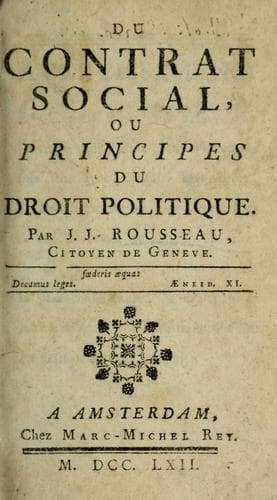
About this book
"Du contrat social" explores the concept of the social contract as a foundation for political legitimacy and authority. Rousseau argues that individuals can achieve true freedom and equality by collectively agreeing to form a society governed by the general will, which represents the common interests of all citizens. The work critiques existing political structures and emphasizes the importance of civic virtue and participation in governance. Through this philosophical framework, Rousseau seeks to reconcile individual liberty with the needs of the community, laying the groundwork for modern democratic thought.
Why it was banned
Rousseau's The Social Contract was placed on the Index Librorum Prohibitorum in 1762, the same year of its publication. The Church condemned its theory of popular sovereignty, its rejection of divine-right monarchy, and its vision of a secular civil religion that would displace Christianity. The Parlement of Paris simultaneously ordered the book burned and Rousseau arrested. Its ideas directly inspired the French Revolution and subsequent liberal democratic movements, all of which the Church officially opposed. It remained on the Index until 1966.
Censorship history
"Du contrat social" was banned by the Vatican City in 1762 due to its critiques of political authority and promotion of secularism, leading to its condemnation for blasphemy and popular sovereignty theory. The book was subsequently burned by the Parlement of Paris the same year, and it remained on the Catholic Church's Index Librorum Prohibitorum until it was lifted in 1966. This ban reflected broader concerns about Enlightenment ideas challenging traditional religious and political structures during that period.
Bans
| Country | Year | Reasons | ||
|---|---|---|---|---|
| Vatican City (Holy See) | 1762lifted | ReligiousPolitical | ||
| Condemned in 1762 for popular sovereignty theory and secularism. Burned by the Parlement of Paris the same year. On the Index until 1966. | ||||