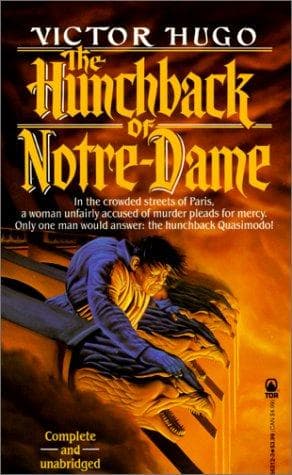
About this book
Set in 15th-century Paris, "The Hunchback of Notre-Dame" explores themes of love, social injustice, and the struggle for acceptance. The story revolves around the tragic figure of Quasimodo, the deformed bell-ringer of Notre-Dame Cathedral, and his unrequited love for the beautiful Esmeralda. Through its vivid portrayal of the city's architecture and the lives of its inhabitants, the novel critiques the rigid social hierarchies and moral complexities of the time. Hugo's work emphasizes the conflict between inner beauty and societal judgment, ultimately highlighting the human capacity for compassion and redemption.
Why it was banned
Victor Hugo's Notre-Dame de Paris (The Hunchback of Notre-Dame) was placed on the Index Librorum Prohibitorum in 1834. The Church objected to Hugo's portrayal of corrupt and lustful clergy — particularly the archdeacon Frollo — and to his implicit critique of the Church's indifference to human suffering. The novel also romanticised a medieval world the Church felt it owned the narrative of. It remained on the Index until 1966.
Censorship history
"The Hunchback of Notre-Dame" was banned in Vatican City in 1834, primarily due to its portrayal of corrupt clergy and its anti-clerical themes, leading to its inclusion on the Church's Index of Forbidden Books, where it remained until 1966. This ban reflected the Church's concerns over the novel's moral implications and its challenge to religious authority during a time of significant social upheaval in Europe.
Bans
| Country | Year | Reasons | ||
|---|---|---|---|---|
| Vatican City (Holy See) | 1834lifted | MoralReligious | ||
| Added to the Index in 1834 for its portrayal of corrupt clergy and anti-clerical subtext. On the Index until 1966. | ||||